


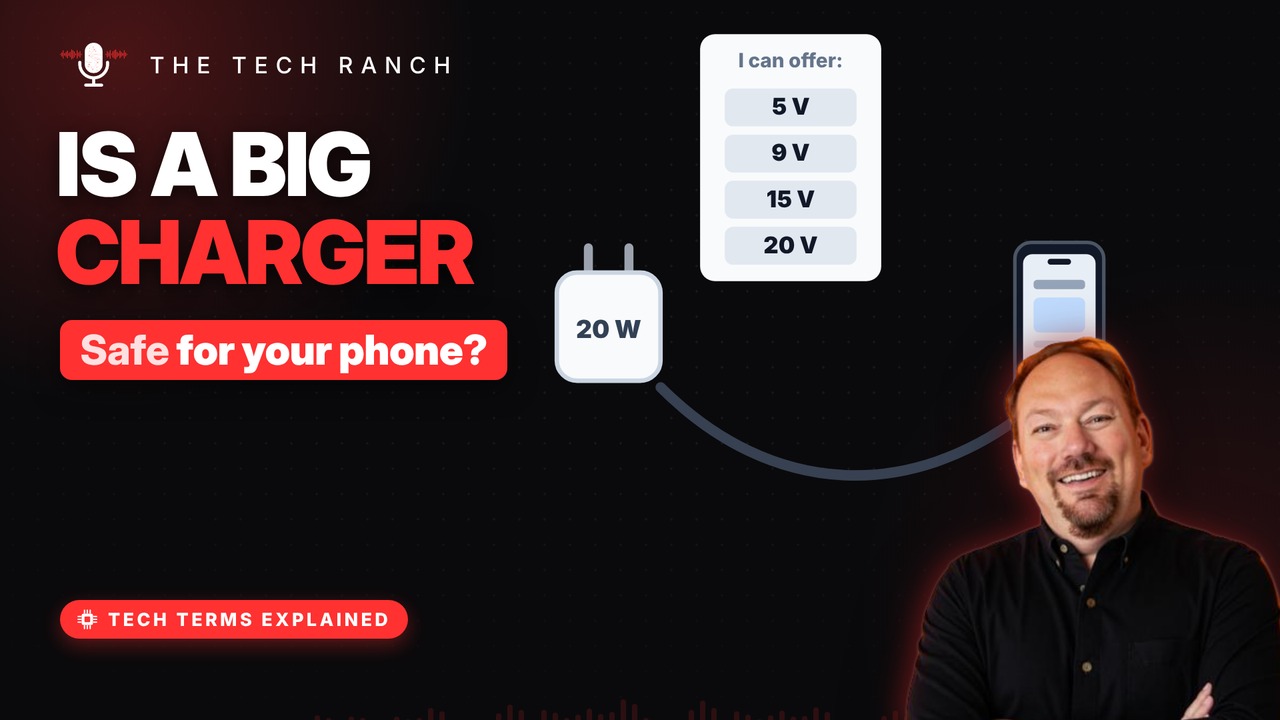
Watts are volts times amps, and fast chargers simply raise the voltage after checking what your phone can handle. This animated explainer shows why a bigger USB-C charger won’t fry your phone, why charging slows near full, and why heat is the real enemy of your battery.
Volts × amps = watts
Think of electricity like water in a hose. Volts are the pressure. Amps are the flow. Multiply them and you get watts: the total power. More watts = more energy per second = faster fill.
How fast charging speeds up
Basic USB power is 5 volts. Fast chargers can step up to 9, 15 or 20 volts. Higher voltage pushes more watts down the cable. That’s how a phone fills up so much quicker.
Your phone is the boss
Before charging, phone and charger talk. The charger says what it can offer. The phone picks the level it can safely take. So a bigger charger won’t force extra power in.
Why it slows near full
Charging starts fast while the battery is low. Near full, the phone eases off the current. That limits heat and stress on the battery. Many phones go fast to 80%, then trickle.
Heat is the real enemy
Fast charging makes some heat. Heat is a battery’s main enemy. Above 95°F (35°C), batteries can lose capacity for good. Charge somewhere cool, and skip cheap knockoff chargers.
Bonus: Why it pauses at 80%
Some phones pause at 80% overnight. They learn when you usually unplug. Then they finish charging just before you wake.
More Tech Terms, Explained
This is part of my Tech Terms Explained series: everyday tech words, explained in plain English, with simple animations. Watch the whole series on YouTube and subscribe to The Tech Ranch so you don’t miss the next one. Short on time? Here’s the quick Short version.
Found this helpful? Give the video a thumbs up on YouTube. Got a tech word you’d like explained? Ask in the YouTube comments and it might be the next video.