


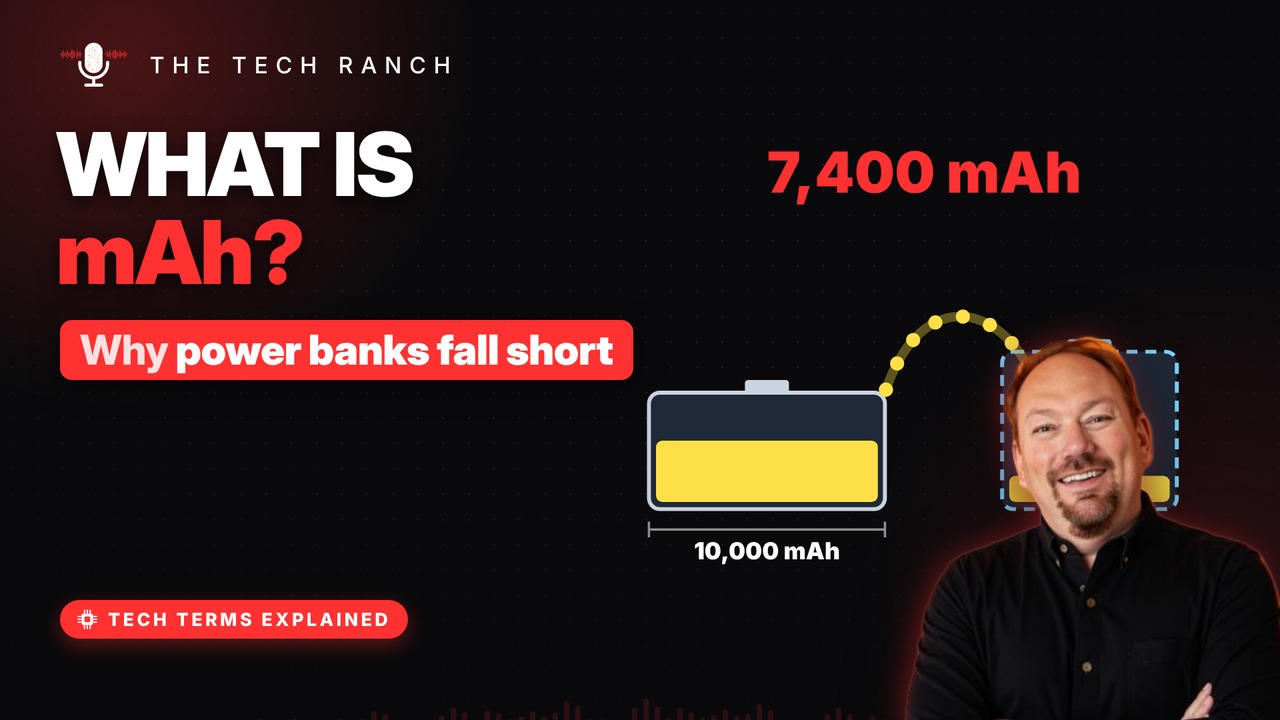
mAh, or milliamp-hours, measures how much electric charge a battery holds, not how much energy. This animated explainer shows why a 10,000 mAh power bank can’t deliver 10,000 mAh to your phone, why watt-hours are the fairer comparison, and why airlines limit batteries by Wh.
Milliamp-hours, decoded
mAh = milliamp-hours. It’s how much electric charge a battery holds. 1 mAh = 1 milliamp of current for 1 hour. So 5,000 mAh could supply 5,000 mA for an hour.
The missing piece: volts
mAh measures charge, not energy. Energy also depends on voltage. Watt-hours (Wh) include both: mAh × volts ÷ 1,000. That’s why Wh is the fairer way to compare.
The power bank surprise
Power bank cells are rated at about 3.7 volts. USB output runs at 5 volts, so the mAh number shrinks. 10,000 mAh at 3.7 V is about 7,400 mAh at 5 V. Some energy is also lost as heat along the way.
Why airlines count Wh
Airlines care about energy, so they use watt-hours. US rules allow up to 100 Wh per spare battery. Up to 160 Wh with airline OK; some are stricter. Spare power banks go in carry-on, never checked.
Compare batteries the smart way
Same kind of battery? Higher mAh means more charge. Different voltages? Compare watt-hours instead. Laptops often list Wh; phones often list mAh. Battery life also depends on screen, chip and apps.
Bonus: Do the math yourself
Find the mAh and the voltage on the label. Multiply them, then divide by 1,000. 10,000 mAh × 3.7 V ÷ 1,000 = 37 Wh.
More Tech Terms, Explained
This is part of my Tech Terms Explained series: everyday tech words, explained in plain English, with simple animations. Watch the whole series on YouTube and subscribe to The Tech Ranch so you don’t miss the next one. Short on time? Here’s the quick Short version.
Found this helpful? Give the video a thumbs up on YouTube. Got a tech word you’d like explained? Ask in the YouTube comments and it might be the next video.