


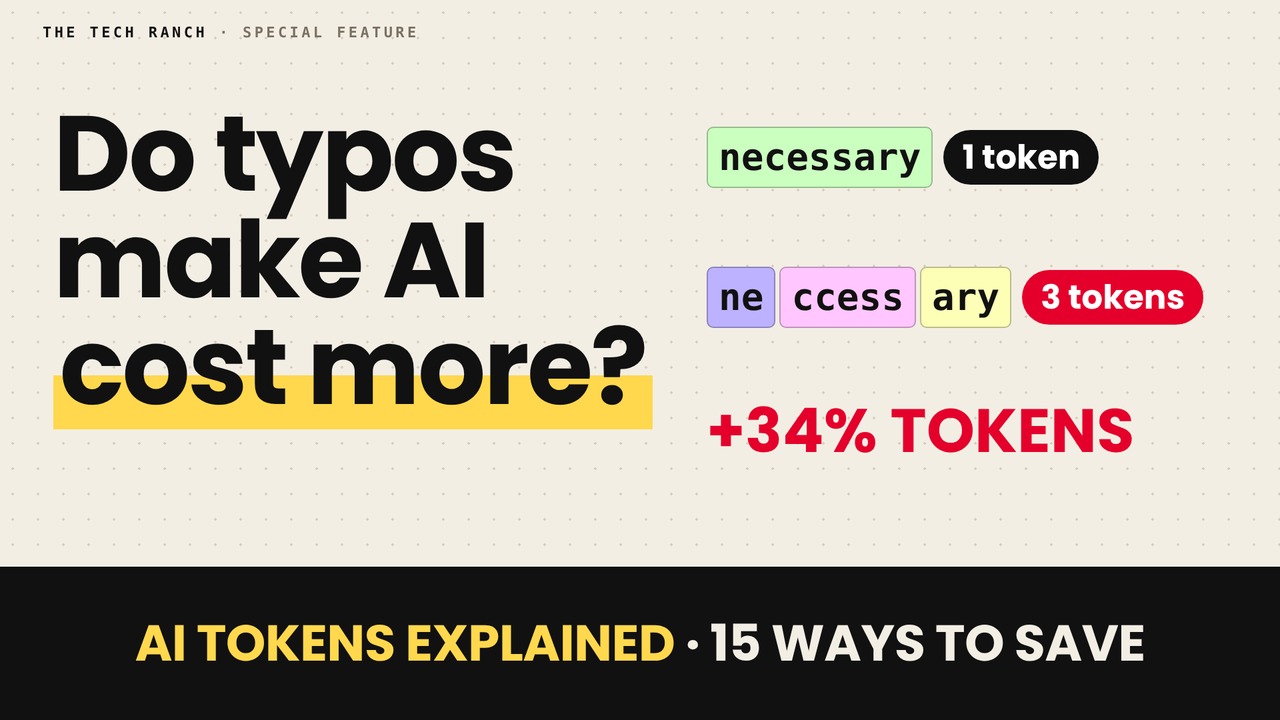
If you use ChatGPT, Claude, Gemini or any other AI chatbot, you’ve probably seen the message that you’ve hit your limit and need to wait. That raises a fair question: do typos and misspellings make AI use more tokens, so you run out faster or pay more? I ran real words and sentences through a real AI tokenizer to find out. The answer surprised me a little, and it pointed to much bigger token-wasters that most people never think about.
The Short Answer
Yes, typos cost a little more, but only a little. A misspelled word often gets chopped into two to four tokens instead of one. In my test, a 30-word request full of typos used 43 tokens. The same request spelled correctly used 32, about a third more. But that’s small change. What really drains your AI plan is long conversations, wrong information that sends the AI down the wrong path, big files, extra tools like web search, “thinking” modes and long answers. Fix those, and typos stop mattering.
First: What Is a Token?
AI language models don’t read words the way you do. They read tokens, which are chunks of text. A common word like “the” or “computer” is usually a single token. A rare or long word gets split into pieces. “Tokenization” becomes “Token” + “ization,” and “antidisestablishmentarianism” becomes six pieces.
OpenAI’s rule of thumb is that in English, one token is about four characters, or about three-quarters of a word, so 100 tokens is roughly 75 words. Every AI company uses its own tokenizer, but they all work the same basic way.
Tokens are the meter for AI. If you use an AI company’s API, as developers do, you’re billed per token, and input and output are priced separately. If you have a subscription like ChatGPT Plus or Claude Pro, you aren’t billed per token, but your usage limits are based on how much work the AI does, and that comes down to tokens.
I Tested It: Do Misspelled Words Use More Tokens?
I ran correctly spelled words and common misspellings through OpenAI’s own tokenizer (called o200k, used by GPT-4o and newer models), and double-checked them with its older tokenizer (cl100k). Here’s what came back:
| Spelled right | Tokens | Misspelled | Tokens | How it got split |
|---|---|---|---|---|
| necessary | 1 | neccessary | 3 | ne | ccess | ary |
| restaurant | 1 | restraunt | 3 | rest | ra | unt |
| because | 1 | becuase | 3 | bec | u | ase |
| environment | 1 | enviroment | 3 | env | iro | ment |
| spreadsheet | 1 | spreadhseet | 4 | spread | h | se | et |
| computer | 1 | compuetr | 3 | comp | u | etr |
| dishwasher | 1 | dishwaser | 3 | dish | was | er |
| password | 1 | pasword | 2 | pas | word |
Here’s the plot twist: some typos are free. “Definately,” “seperate” and “recieve” each stayed a single token in the newer tokenizer. They’re so common online that the tokenizer learned them as words. (In the older tokenizer, “definately” and “recieve” took two tokens each.)
The Sentence Test
Single words are one thing, but what about a real request? I wrote the same request five different ways and counted the tokens:
| Version | Example | Tokens |
|---|---|---|
| Trimmed to the point | “Write a polite email to my landlord asking when the broken dishwasher will be repaired. I need it fixed before my family visits next weekend.” | 27 |
| Spelled correctly | “Can you help me write a polite email to my landlord asking when the broken dishwasher will be repaired? I definitely need it fixed…” | 32 |
| Text-speak | “can u help me w/ a polite email 2 my landlord askin when the broke dishwasher gets fixed?? def need it b4 fam visits nxt wknd” | 32 |
| With 13 typos | “Can you help me writ a pollite emial to my landord asking wen the brokn dishwaser will be repaird?…” | 43 (+34%) |
| With chatty filler | “Hi there! I hope you’re having a wonderful day. I was just wondering if you could possibly help me out…” | 79 |
Three takeaways:
- A typo costs zero to three extra tokens. Thirteen typos added 11 tokens to this request.
- Abbreviating doesn’t save anything. The text-speak version was shorter to read but cost exactly the same 32 tokens.
- Small talk costs more than typos. Two friendly sentences of filler more than doubled the request.
The Bigger Problem With Typos: Confusing the AI
The extra tokens aren’t the real risk. The real risk is that the AI misreads what you meant. Researchers studying this (Tokenization Falling Short, 2024) found that character-level typos hurt the performance of every model they tested, including GPT-4 Turbo. Bigger models handled typos better, but none were immune.
A misread request leads to a wrong answer, and you ask again. Every one of those follow-ups costs far more than the typo did, because of the hidden meter.
The Hidden Meter: Your Whole Conversation Is Re-Read Every Time
This is the part most people don’t know. An AI model doesn’t remember your chat between messages. Each time you send a message, the app sends the entire conversation so far back to the model along with your new question. Anthropic’s documentation for Claude describes each turn’s input as containing “all previous conversation history plus the current user message” (Claude docs: context windows).
Here’s what that looks like in a chat where each question is about 60 tokens and each answer about 400:
| Turn | Tokens sent to ask a 60-token question |
|---|---|
| 1 | 60 |
| 5 | 1,900 |
| 10 | 4,200 |
| 20 | 8,800 |
| 30 | 13,400 |
Add it all up and those 30 questions processed about 213,900 tokens. Ask the same 30 questions as three fresh 10-question chats and the total drops to about 75,900, roughly a third. One long, wandering chat is the single biggest token-waster for most people.
Some apps soften this. Claude caches project documents so re-reading them counts for less, and very long chats may be trimmed or summarized automatically. But longer chats still use more. Anthropic’s own help pages list conversation length as a main factor in how fast you use your limit.
Wrong Information Is the Expensive Mistake
Give an AI a wrong date, a wrong number, the wrong file or a fuzzy request, and it will build a whole answer on it. Then you correct it, and it redoes the work. Each correction re-sends the entire conversation, and the wrong version stays in the history, where it keeps getting re-read and can keep confusing the AI.
In my example chat, two correction rounds at turn 10 cost about 10,580 extra tokens. My 13 typos added 11 tokens, less than one token each, so that’s the cost of more than 10,000 typos. If a chat has gone off the rails, don’t keep arguing with it. Start a new chat with the correct information.
What Actually Uses Up Your AI Plan
- Long conversations. The whole thread is re-sent with every message.
- Files, PDFs and screenshots. Each one is turned into tokens and carried along in the conversation.
- Tools and web search. Anthropic calls tools and connectors “token-intensive” (Claude help: usage and length limits).
- Thinking and reasoning modes. The AI’s hidden reasoning is billed as output tokens even though you never see it (OpenAI: reasoning models).
- Long answers. Output costs more than input. On Anthropic’s API at the time of writing, output tokens cost five times as much as input tokens. For example, Claude Sonnet 5.5 is $2 per million tokens in and $10 per million out (Claude pricing).
- Bigger models. The most capable models use up your allowance faster than lighter ones.
On Claude’s paid plans, usage runs on a five-hour session limit plus weekly limits, shared across the Claude apps. ChatGPT’s limits vary by plan and model and change often, so check your plan’s help page for current numbers.
15 Ways to Make Your AI Tokens Go Further
- Start a new chat for each new topic. A fresh chat doesn’t drag the whole old conversation along.
- Summarize, then restart. When a chat gets long, ask “Summarize this chat in 10 bullets,” then paste that into a new chat.
- Get the facts right before you ask. Names, dates, numbers and the right file. Wrong information is the most expensive mistake.
- Say it all in your first message. Goal, audience, format and length. Instead of “Write an email,” try “Write a 120-word email to my landlord, friendly but firm, asking for a repair date.”
- Batch related questions. Three related questions in one message, not three separate messages. This is Anthropic’s own advice.
- Ask for the length you need. “In 5 bullets.” “Under 150 words.” Output is the expensive part.
- Ask for just the changes. “Show only the fixed paragraph” instead of getting the whole document back.
- Skip the small talk. Being polite is fine. Paragraphs of filler cost more than typos.
- Proofread what matters. A typo in a name, number or key term can change the answer. Typos elsewhere barely matter.
- Paste only what’s needed. The relevant section, not the whole 40-page PDF.
- Reuse documents in a project. In Claude, project files are cached, and cached content counts less against your limits.
- Turn off tools you don’t need. Web search, connectors and extended thinking all use extra tokens.
- Match the model to the job. Use a smaller, faster model for simple tasks and save the big one for hard problems.
- Edit instead of piling on. Edit your original message rather than adding a correction. Editing replaces the bad version, so it isn’t re-read.
- Watch your usage meter. In Claude, check Settings > Usage, and plan big jobs right after a reset.
Quick Checklist
- One topic per chat
- Facts right the first time
- Everything in your first message
- Ask for short answers
- Edit, don’t pile on corrections
- Tools off unless you need them
The Bottom Line
Do typos make AI cost more? A little, usually zero to three extra tokens per mistake, and common misspellings are often free. Don’t stress about spelling. Stress about long chats, wrong information and asking for more than you need. Get those right and your AI plan will go a lot further.
Subscribe to The Tech Ranch for more plain-English tech explainers. Short on time? Here’s the quick Short version. If this saved you some tokens, give the video a thumbs up on YouTube, and tell me your best AI-saving tip in the comments.
Sources
- OpenAI: What are tokens and how to count them
- Anthropic: Context windows (Claude docs)
- Anthropic: Understanding usage and length limits
- Anthropic: Usage limit best practices
- Anthropic: Claude API pricing
- OpenAI: Reasoning models
- Tokenization Falling Short: The Curse of Tokenization (2024)
- Token counts measured with OpenAI’s o200k_base and cl100k_base tokenizers (gpt-tokenizer), November 2026.