


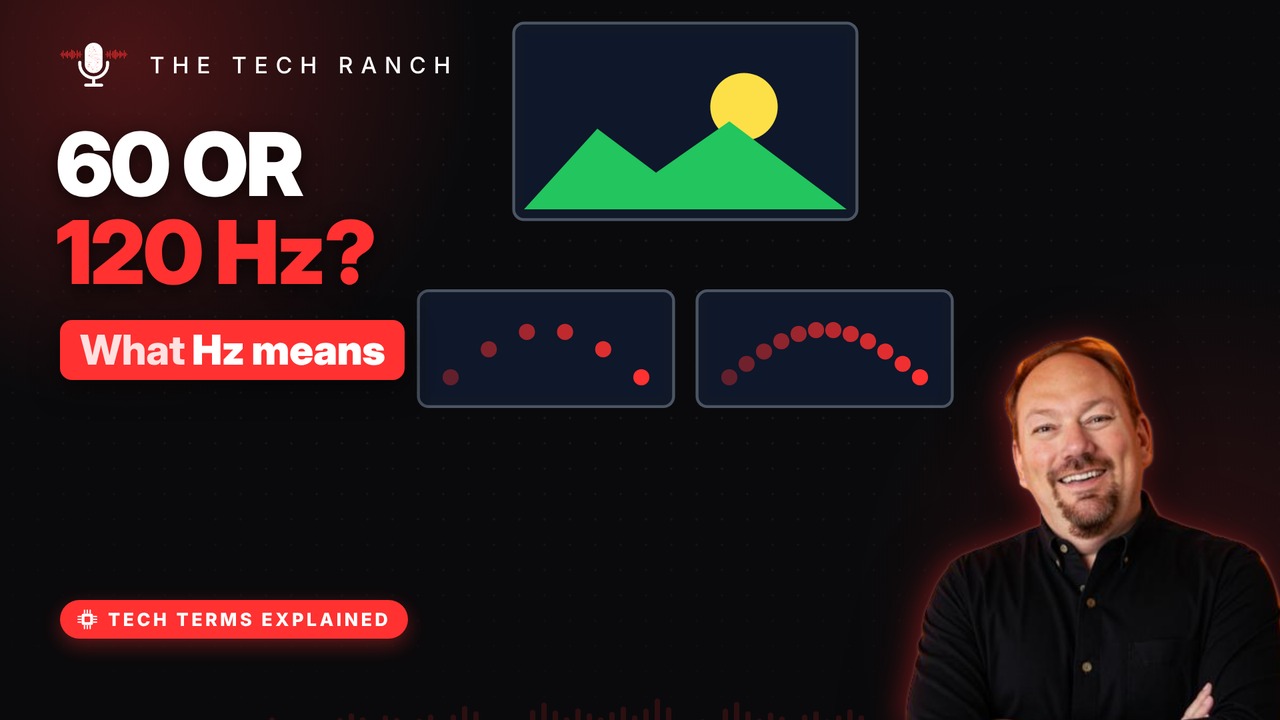
Refresh rate, measured in hertz, is how many times a second your screen redraws its picture. This animated explainer shows why 120 Hz looks smoother than 60 Hz, how refresh rate differs from a video’s frame rate, and why 60 became the standard in the first place.
A super-fast flip book
Video is a series of still pictures. Shown fast enough, your brain sees motion. The screen swaps in a new image again and again. Hz (hertz) means ‘times per second.’.
Redrawing nonstop
Refresh rate is how often the screen redraws. A 60 Hz screen redraws 60 times a second. It does this even if nothing on screen changes. A 120 Hz screen redraws twice as often.
Why 120 Hz feels smoother
More redraws mean smaller jumps between images. Scrolling and fast games look smoother. Redrawing more often takes more power. Some phones drop to 1 Hz on still screens to save battery.
Refresh rate vs. frame rate
Refresh rate is the screen’s top speed. Frame rate (fps) is how many images the video has. Most movies are filmed at 24 frames per second. A faster screen just repeats frames the video lacks.
Why 60 became normal
US household power cycles 60 times a second. Early TVs matched it to avoid wavy picture glitches. That kept TV sets simpler and cheaper. Screens still run at 60 Hz or multiples of it.
Bonus: Inflated ‘motion’ numbers
Some TV boxes boast big ‘motion’ numbers. Those can be higher than the screen’s real refresh rate. Look for the ‘native’ refresh rate in the specs.
More Tech Terms, Explained
This is part of my Tech Terms Explained series: everyday tech words, explained in plain English, with simple animations. Watch the whole series on YouTube and subscribe to The Tech Ranch so you don’t miss the next one.
Found this helpful? Give the video a thumbs up on YouTube. Got a tech word you’d like explained? Ask in the YouTube comments and it might be the next video.