


By Marlo Anderson – The Tech Ranch
The Moon looks close enough to touch. It’s not. Here’s how far away it really is, and how long it takes to get there by car, by rocket and on the fastest trip ever.
How Far Is the Moon?
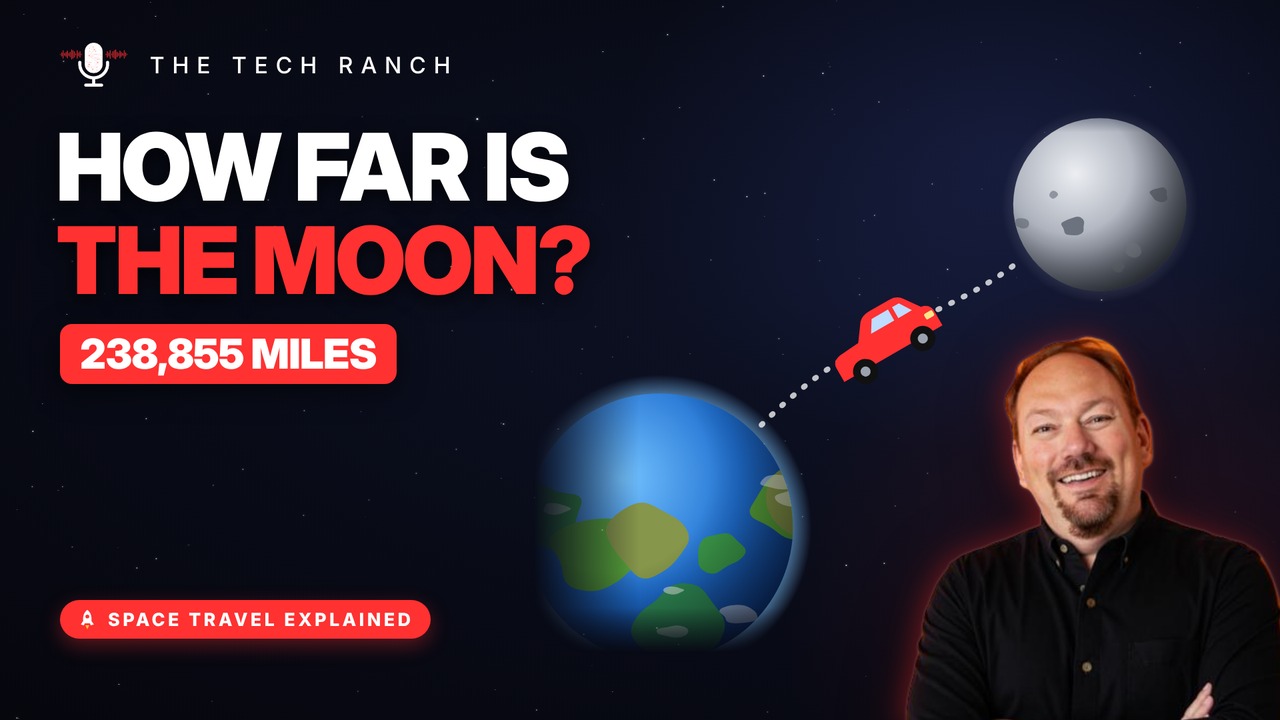
On average, the Moon is about 238,855 miles (384,400 km) away. Its orbit isn’t a perfect circle, so that changes a bit. The gap would hold about 30 Earths side by side, and light crosses it in about 1.3 seconds.
All the Planets Fit in the Gap
Here’s a wild one: when the Moon is at its farthest point, you could line up all the other planets side by side between Earth and the Moon, even giant Jupiter and Saturn.
Could You Drive There?
Picture a highway to the Moon. At 60 mph, with no stops for gas, food or sleep, you’d arrive in about 166 days, about five and a half months.
Apollo Took About 3 Days
Apollo 11 launched on July 16, 1969 and slipped into orbit around the Moon about 3 days later, coasting along a curved path, not a straight line. On July 20, people walked on the Moon.
The Fastest Trip Past the Moon
In 2006, NASA’s New Horizons probe shot past the Moon’s distance in just 8 hours 35 minutes on its way to Pluto. Trips that stop at the Moon take a lot longer.
Artemis II Sets a Record
In April 2026, four astronauts flew around the Moon on Artemis II, passing about 4,067 miles above the far side. At one point they were 252,756 miles from Earth, farther than any humans before, beating Apollo 13’s record.
Bonus Fact: The Moon Call Delay
Radio waves take about 1.3 seconds to reach the Moon, so every question and answer has about a 2.6-second round-trip delay.
More Space Travel, Explained
This is part of my Space Travel Explained series: big space questions, answered in plain English with simple animations. Watch the whole series on YouTube and subscribe to The Tech Ranch so you don’t miss the next one.
Found this helpful? Give the video a thumbs up on YouTube. Got a space question you’ve always wondered about? Ask it in the YouTube comments and it might be the next video.