


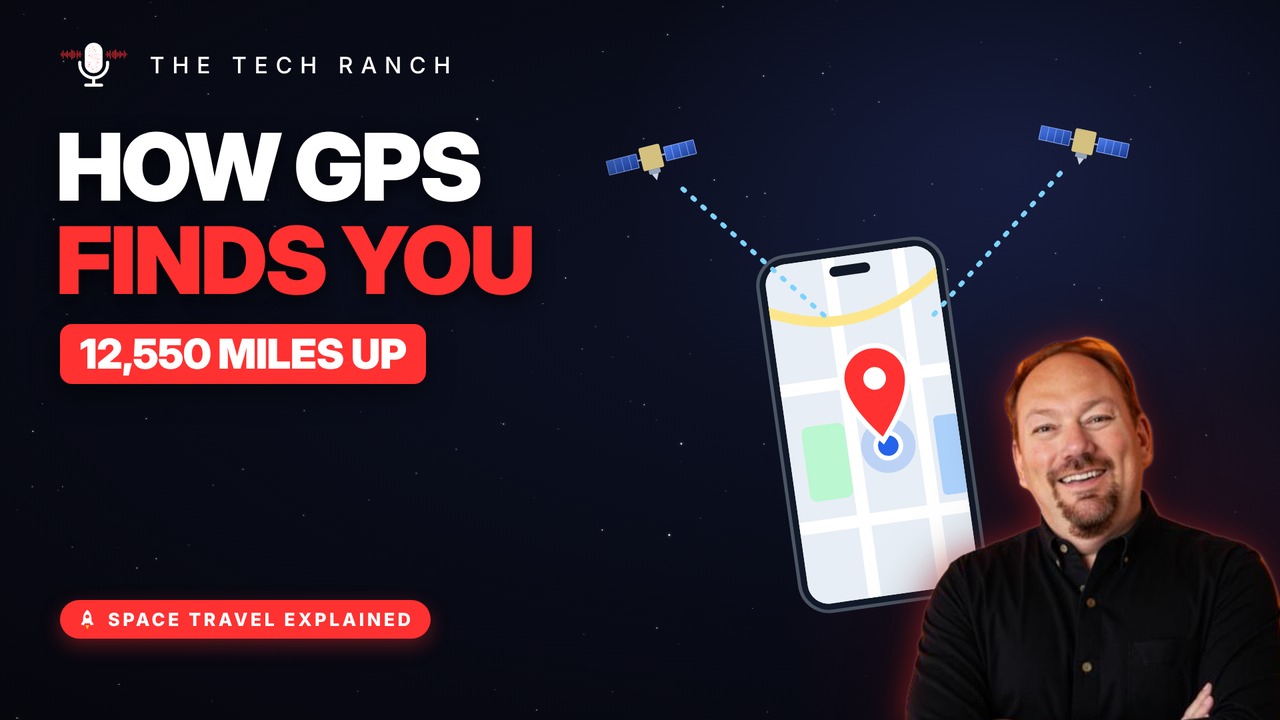
By Marlo Anderson – The Tech Ranch
Open a map app and a blue dot shows exactly where you are, even with no cell signal. That dot comes from satellites more than 12,000 miles up, and a clever trick with time.
Satellites That Only Talk
About 32 working GPS satellites circle Earth about 12,550 miles (20,200 km) up, each one going around about twice a day. They only send signals. Your phone never talks back.
It’s All About Timing
Each satellite keeps broadcasting where it is and the exact time. The signal travels at the speed of light, so your phone can tell how long the trip took, and time × speed = distance.
Where the Circles Cross
One distance puts you somewhere on a circle. A second satellite narrows it to two spots. A third leaves just one spot that fits: you. It’s called trilateration.
Why It Takes Four
Your phone’s clock is good but not perfect, and being off by just 1/1,000 of a second would put you about 186 miles off. A fourth satellite lets your phone correct its own clock, so GPS needs at least four in view.
Atomic Clocks and Einstein
Each satellite carries super-precise atomic clocks. Up in orbit, time runs a tiny bit faster, just as Einstein predicted: about 38 millionths of a second a day. Left uncorrected, GPS would drift about 6 miles a day.
How Close Is It?
Under open sky, phones are typically accurate to within about 16 feet. Tall buildings and bridges can block or bounce signals, which is why your dot wanders downtown. Phones also use Wi-Fi and cell towers to help.
Bonus Fact: GPS Is Free
GPS is run by the U.S. Space Force and is free for anyone on Earth. Many phones also use Europe’s Galileo, Russia’s GLONASS and China’s BeiDou.
More Space Travel, Explained
This is part of my Space Travel Explained series: big space questions, answered in plain English with simple animations. Watch the whole series on YouTube and subscribe to The Tech Ranch so you don’t miss the next one.
Found this helpful? Give the video a thumbs up on YouTube. Got a space question you’ve always wondered about? Ask it in the YouTube comments and it might be the next video.