


By Marlo Anderson – The Tech Ranch
Some spacecraft are billions of miles from home, and NASA still talks to them every day. Here’s how, plus the milestone Voyager 1 is about to reach.
Messages at Light Speed
We talk to spacecraft with radio waves, which travel at the speed of light: about 186,000 miles a second. Space is huge, though: a message takes about 1.3 seconds to reach the Moon and 3 to 22 minutes to reach Mars.
Giant Ears on Earth
NASA listens with its Deep Space Network. Its biggest dishes are 230 feet (70 m) across, wider than a jumbo jet’s wingspan, so they can catch more of a faint signal.
Three Sites Around the World
The big dishes sit in California, Spain and Australia, spread around the globe so that as Earth spins, one is always facing the spacecraft. NASA never loses sight of its far-off missions.
A Super-Faint Signal
By the time a signal gets here, it’s about 20 billion times weaker than the power a digital watch needs. Giant dishes and sensitive electronics pick it out of the static.
Meet Voyager 1
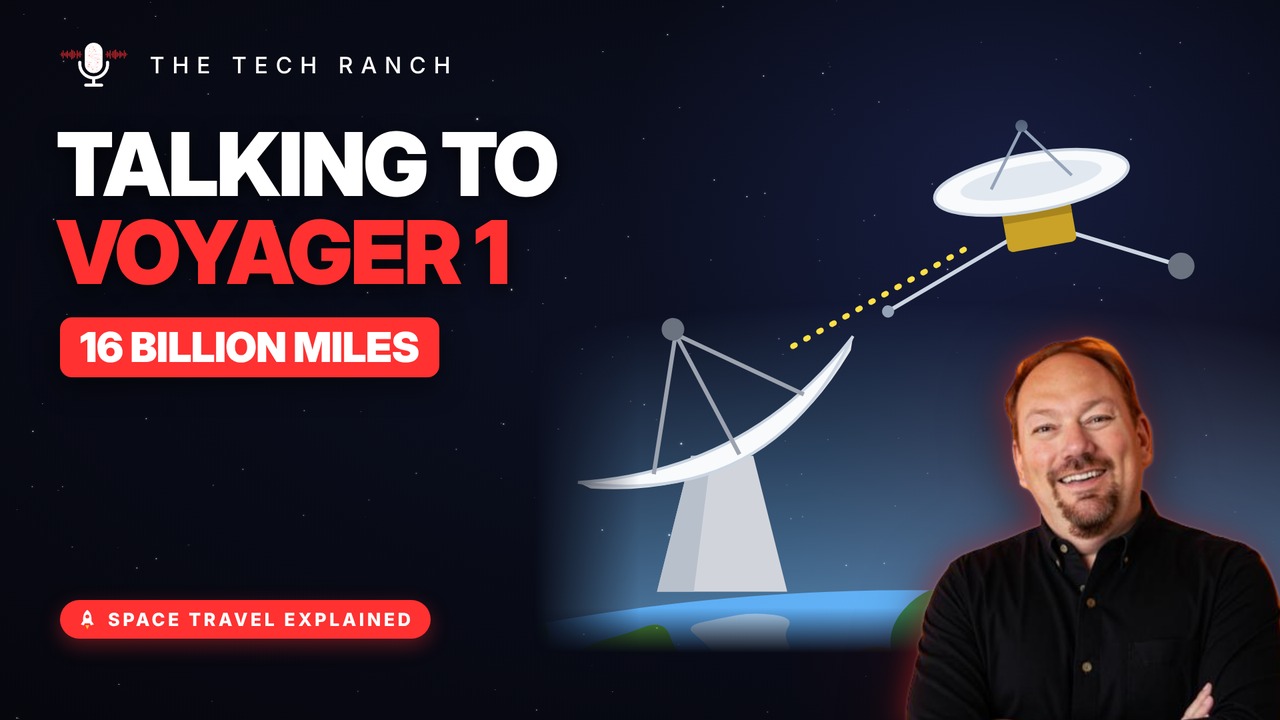
Launched in 1977, Voyager 1 is still sending messages from about 16 billion miles away, the farthest human-made object ever. Its radio runs on just 23 watts, about like a fridge light bulb.
One Light-Day Away
On November 18, 2026, Voyager 1 reaches one light-day from Earth. A message will take a full 24 hours to get there, so a question and its answer take two days.
Bonus Fact: The Golden Record
Each Voyager carries a 12-inch, gold-plated Golden Record with sounds and pictures of Earth, music, and greetings in 55 languages.
More Space Travel, Explained
This is part of my Space Travel Explained series: big space questions, answered in plain English with simple animations. Watch the whole series on YouTube and subscribe to The Tech Ranch so you don’t miss the next one.
Found this helpful? Give the video a thumbs up on YouTube. Got a space question you’ve always wondered about? Ask it in the YouTube comments and it might be the next video.